
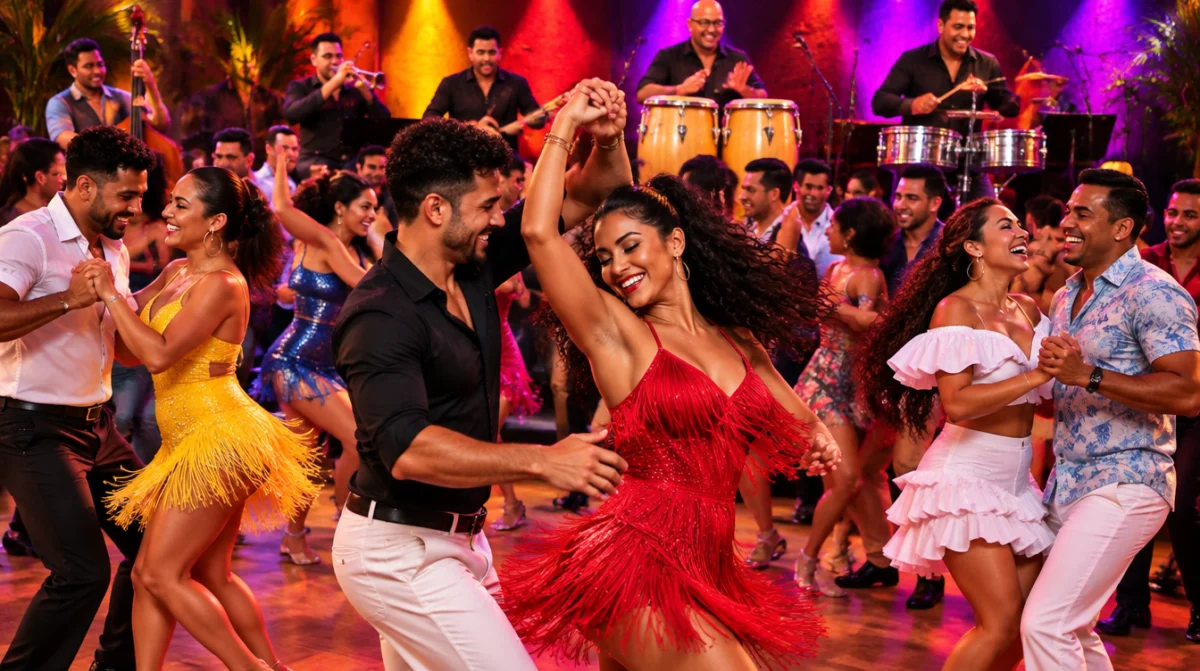
Quick answer: the most popular Latin dances are salsa and cha-cha (Cuban roots), bachata and merengue (Dominican Republic), samba (Brazil), tango (Argentina and Uruguay) and cumbia (Colombia). Most are partner dances shaped by African, European and Indigenous influences. In ballroom competitions, «Latin» refers to a fixed set: samba, cha-cha, rumba, paso doble and jive.
«Latin dance» is used in two ways. In social dancing it means the dances born in Latin America and the Caribbean that people dance at clubs and parties. In ballroom competition it is a category with five specific dances. This guide covers both, with the origin and character of each dance.
Social Latin dances
Salsa
Rooted in Cuban son, mambo and guaracha, salsa took shape in New York in the 1960s and 1970s, where Cuban and Puerto Rican musicians added jazz arrangements. It is danced in a slot (On1, On2) or in a circle in Cuban casino style. Fast, with many turns. Learn the basics in how to dance salsa.
Bachata
Guitar music from the Dominican Republic that emerged in the 1960s. The basic is three steps and a tap; styles include Dominican, sensual and fusion. Inscribed by UNESCO as intangible cultural heritage in 2019. See how to dance bachata.
Merengue
The national dance of the Dominican Republic, with a step on every beat and a marching feel. It is the easiest Latin dance for absolute beginners. Inscribed by UNESCO in 2016.
Cha-cha
Created in Cuba in the early 1950s from danzón and mambo; the violinist Enrique Jorrín is credited with the first cha-cha-chá compositions. Its signature is the triple step «cha-cha-cha». It exists as a social dance and as a ballroom Latin dance.
Mambo
Cuban music that exploded in the late 1940s and 1950s with bandleaders such as Dámaso Pérez Prado, and became a dance craze in New York. Today «mambo» is also used for On2 salsa in New York style.
Cumbia
Born on Colombia’s Caribbean coast from Indigenous, African and Spanish influences. It spread across Latin America and developed local styles in Mexico, Peru and Argentina. Danced with small steps and a gentle sway.
Argentine tango
Born in the late 19th century around the Río de la Plata, in Buenos Aires and Montevideo. It is an improvised dance in a close embrace, danced at milongas. UNESCO inscribed tango in 2009.
Brazilian zouk and kizomba
Brazilian zouk developed in Brazil from lambada, with flowing head and torso movements. Kizomba comes from Angola, so it is not Latin American, but it is usually taught alongside Latin dances in the same studios and socials.
Reggaeton
Urban Latin music associated with Puerto Rico and Panama. It is usually taught as solo choreography rather than as a partner dance.
Ballroom Latin dances
In International-style competitions, the Latin category includes exactly five dances, with standardized technique:
| Dance | Origin | Character |
|---|---|---|
| Samba | Brazil | Bouncy, festive, traveling around the floor |
| Cha-cha | Cuba | Playful, with the triple cha-cha-cha step |
| Rumba | Cuban roots | Slow and sensual, focused on hip action |
| Paso doble | Spain and France | Dramatic, inspired by the bullfight |
| Jive | United States | Fast and energetic, derived from swing and rock and roll |
Ballroom rumba is very different from traditional Cuban rumba (guaguancó, yambú and columbia), which is a percussion and dance tradition inscribed by UNESCO in 2016.
How to tell them apart by the music
- Horns, piano and fast percussion: salsa or mambo.
- Romantic song led by a high-pitched guitar: bachata.
- Accordion or sax over a fast, marching beat: merengue.
- Medium tempo with a clear «cha-cha-cha»: cha-cha.
- Bandoneon and violins: tango.
- Accordion or guacharaca over a steady, swaying rhythm: cumbia.
Which Latin dance should you learn first?
Start with merengue or bachata if you want quick results; add salsa once you feel comfortable with timing. If you are drawn to ballroom, a cha-cha or rumba class is a good entry point. Read our comparison of salsa vs bachata or the full guide to types of dance.
Miami is one of the best cities in the US to learn Latin dances. Browse salsa, bachata and ballroom studios in our directory.
Frequently asked questions
What are the most popular Latin dances?
Salsa, bachata, merengue, cha-cha, samba, Argentine tango and cumbia are the most widely danced.
What are the five ballroom Latin dances?
Samba, cha-cha, rumba, paso doble and jive, in International-style competition.
What is the easiest Latin dance?
Merengue, because you step on every beat. Bachata is also easy for beginners.
Is tango a Latin dance?
Argentine tango comes from Argentina and Uruguay, so it is a Latin American dance, but in ballroom competition tango belongs to the Standard category, not Latin.