
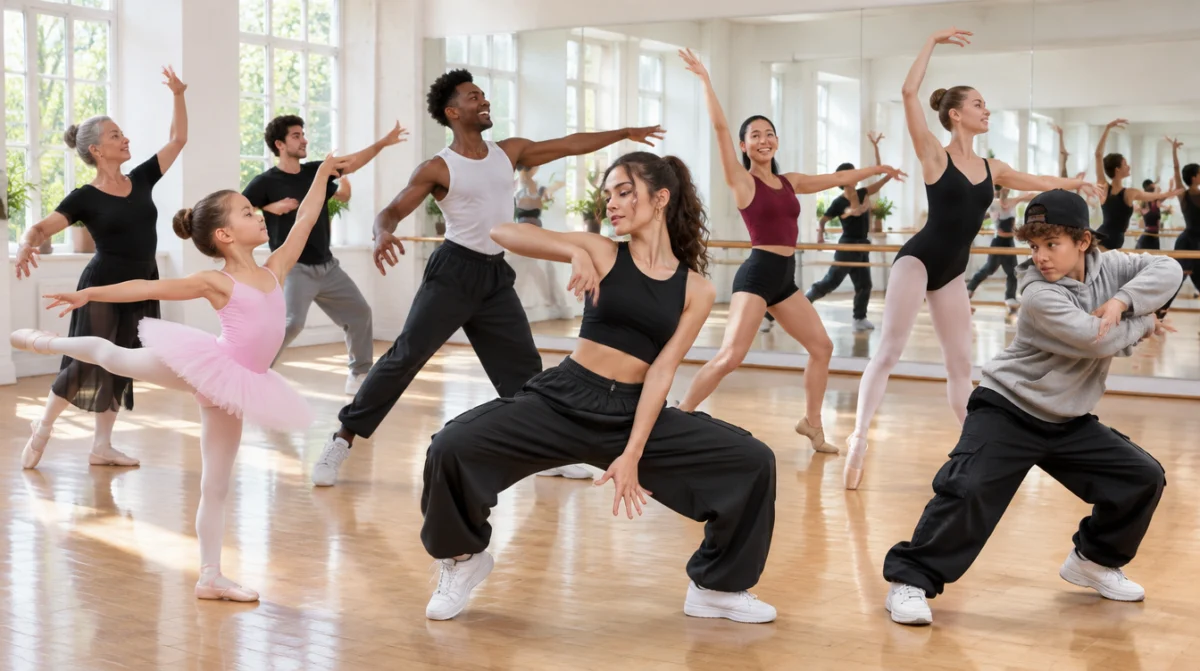
Quick answer: most dances taught in studios fall into five families: Latin social dances (salsa, bachata, merengue), ballroom (waltz, foxtrot, tango, cha-cha), concert dance (ballet, jazz, contemporary), street dance (hip hop, breaking, house) and folk dances (flamenco, cumbia, Irish dance). Merengue and bachata are the easiest to start with; ballet gives the strongest technical base.
There are hundreds of dance styles around the world, but you do not need to know them all to pick a class. What matters is the family a style belongs to: a social partner dance you improvise at a party feels very different from a concert dance built for the stage. This guide covers the most popular types of dance, where they come from and what makes each one unique.
Latin social dances
Partner dances made for parties and clubs. They are built on simple basic steps and on figures the leader proposes and the follower interprets. Most have Afro-Caribbean roots.
- Salsa. Grew out of Cuban music (son, mambo, guaracha) and the name became popular in New York in the 1960s and 1970s. It is danced in a slot (On1 and On2) or in Cuban casino style, which includes group rueda. See how to dance salsa.
- Bachata. From the Dominican Republic. The basic is three steps and a tap on the fourth beat. UNESCO inscribed bachata music and dance on its intangible heritage list in 2019. See how to dance bachata.
- Merengue. Also Dominican, with a step on every beat; the easiest Latin dance to start with. Inscribed by UNESCO in 2016.
- Cumbia. Born on Colombia’s Caribbean coast and adopted across Latin America, with local versions in Mexico, Peru and Argentina.
- Brazilian zouk and kizomba. Brazilian zouk evolved from lambada and is known for flowing head and torso movements; kizomba comes from Angola and is danced close and slow.
For a deeper look, read our guide to Latin dances and the comparison of salsa vs bachata.
Ballroom dances
Partner dances with codified technique and a closed hold. In competition they are split into two groups:
- Standard: waltz, tango, Viennese waltz, foxtrot and quickstep, danced traveling counterclockwise around the floor.
- Latin: samba, cha-cha, rumba, paso doble and jive.
In the United States there is also the American style, with Smooth (waltz, tango, foxtrot, Viennese waltz) and Rhythm (cha-cha, rumba, East Coast swing, bolero, mambo), popular for social dancing. Argentine tango is a separate, improvised social dance; UNESCO recognized tango as intangible heritage in 2009 at the request of Argentina and Uruguay.
Concert dance
Styles created for the stage and based on technical training. Many people start as children, but most studios also have adult classes.
- Ballet. Emerged in Italian Renaissance courts and developed in France, where Louis XIV founded the Royal Academy of Dance in 1661, which is why its vocabulary is French. It is the technical base of most concert dance.
- Jazz. Combines ballet technique with energetic movement, isolations and turns; central to musical theater and kids’ competitions.
- Modern and contemporary. Modern dance broke away from ballet in the early 20th century (Martha Graham, Doris Humphrey, José Limón); contemporary dance followed, mixing techniques with floor work and improvisation.
- Tap. Dancers make music with metal plates on their shoes. It developed in the United States from African and Irish traditions.
- Lyrical and acro. Lyrical blends jazz and ballet with an expressive tone; acro adds acrobatic skills. Both are common in competition studios.
Street dance
Born outside studios, on the street and in clubs, and now taught as choreography classes.
- Hip hop and breaking. Breaking emerged in the Bronx, New York, in the 1970s and made its Olympic debut at Paris 2024.
- House, popping, locking and waacking. Styles with their own technique, born in US club and funk culture.
- Commercial and heels. Music video and stage choreography; heels is danced in high heels.
- Reggaeton and dancehall. Choreography to urban Latin and Jamaican music.
Folk and traditional dances
Dances tied to a region and its celebrations. Some are taught in specialized schools: flamenco from Andalusia (UNESCO intangible heritage since 2010), Irish step dance, Cuban rumba, samba de roda from Bahia, belly dance and many more.
Comparison table
| Family | Examples | Partner? | Beginner difficulty |
|---|---|---|---|
| Latin social | Salsa, bachata, merengue | Yes | Low to medium |
| Ballroom | Waltz, foxtrot, cha-cha | Yes | Medium |
| Concert | Ballet, jazz, contemporary | No | Medium to high |
| Street | Hip hop, house, heels | No | Low to medium |
| Folk | Flamenco, cumbia, Irish dance | Depends | Medium |
Which type of dance should you choose?
- To go out dancing: bachata, merengue and salsa.
- For a wedding: waltz, foxtrot, bachata or a simple routine built around your song.
- For kids: ballet or jazz as a base, then hip hop, contemporary or acro.
- For fitness without a partner: hip hop, reggaeton or commercial dance.
If you live in Miami, our dance studio directory lists studios by style, including salsa, bachata, ballet and hip hop.
Frequently asked questions
How many types of dance are there?
There is no official number: there are hundreds of traditional dances and modern styles. For learning purposes it is easier to group them into families: Latin social, ballroom, concert, street and folk.
What is the easiest type of dance to learn?
Merengue and bachata, because their basic steps can be learned in one or two classes. Among solo styles, beginner hip hop classes are very accessible.
What are the 10 ballroom dances?
In International style: waltz, tango, Viennese waltz, foxtrot and quickstep (Standard), plus samba, cha-cha, rumba, paso doble and jive (Latin).
What is the difference between modern and contemporary dance?
Modern dance appeared in the early 20th century as a break from ballet and created signature techniques such as Martha Graham's. Contemporary dance came later and mixes techniques with improvisation and floor work.